Spark
By Jason Kumpf, Strategy Advisor · November 2, 2026 · 5 min read
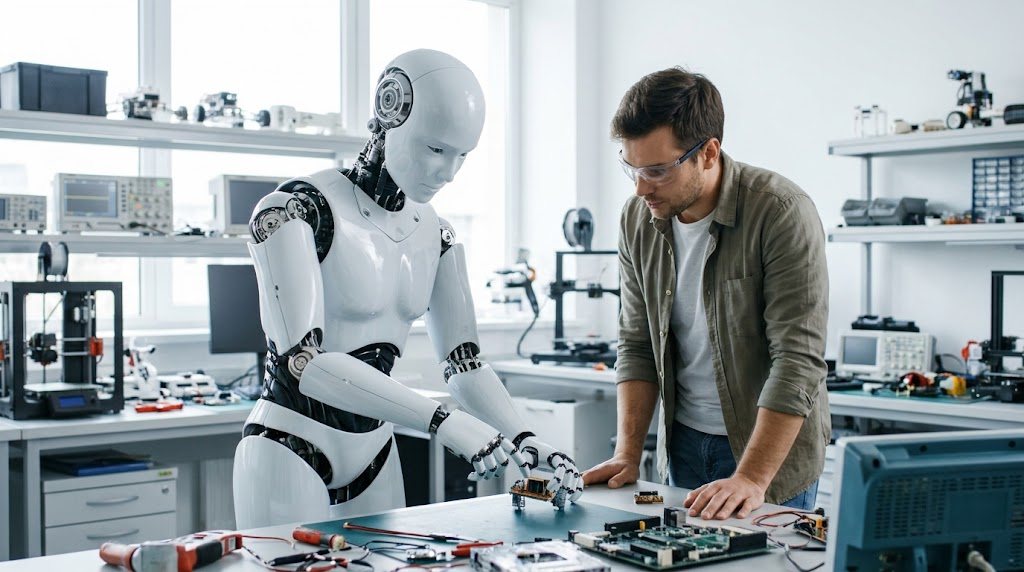
From NVIDIA's open humanoid design to Optimus production in Fremont, 2026 is the year physical AI started clocking in. Here is what is shipping and where founders can build.
Artificial intelligence is stepping off the screen and into the physical world. In 2026, NVIDIA released an open humanoid robot design for researchers, Tesla began early Optimus production in Fremont and Figure AI moved its newest humanoid into a new role at BMW.
The Bay Area sits at the center of this movement. NVIDIA is headquartered in Santa Clara, Tesla builds Optimus in Fremont and Stanford is among the first research centers working with NVIDIA's new humanoid. For founders and investors, physical AI is fast becoming one of the most exciting places to build.
On May 31, 2026, at GTC Taipei, NVIDIA announced the Isaac GR00T Reference Humanoid Robot, which it describes as the first open humanoid reference design built on NVIDIA Jetson Thor. The design pairs a robot body with onboard compute and software in one integrated system, so research teams can move quickly from setup to skill development and real-world testing.
The specifications show how capable an open research platform has become:
Stanford Robotics Center, ETH Zurich, Ai2 and UC San Diego are among the first institutions to use the design. "Robotics moves fastest when researchers can build on open platforms," said Steve Cousins of the Stanford Robotics Center. Unitree will make the robot available in late 2026.
Robots learn faster when they can practice in simulation, and NVIDIA's Cosmos world models are built for exactly that. At GTC Berlin in October 2026, NVIDIA added new training tools, simulation checkpoints and Cosmos Data Factory blueprints. NVIDIA reports that Cosmos ranks in the top five on six open-model leaderboards.
NVIDIA also opened early access to its Factory Operations Blueprint, known as FOX, on GitHub. FOX supports a factory manager agent working alongside specialist agents for inspection, root-cause analysis and fleet management. At Siemens' factory in Erlangen, Germany, agents built with FOX help planners weigh order changes inside a digital twin, and a Cosmos-based circuit-board inspection project targets up to 85% less manual engineering effort.
The lesson for builders is that physical AI is a full stack. The robot is only one layer. Simulation, data, vision models and orchestration software each offer room for new companies.
Tesla shared a major Optimus milestone on its third-quarter 2026 earnings call in October. Elon Musk said the company has started "what I'd call early production on a high-volume line in Fremont." The robots launch with the third-generation design.
Tesla converted space in its Fremont factory for the effort and has described the line as designed for up to 1 million units a year over time. The company has said it expects first deliveries to outside customers around the end of 2027, likely beginning with industrial buyers. A larger line is planned for Giga Texas.
For the Bay Area, a humanoid production line in Fremont is a striking signal. The region that built the personal computer and the smartphone is now building general-purpose robots at industrial scale.
Figure AI has spent more than a year proving humanoids on a real factory floor. At BMW Group Plant Spartanburg in South Carolina, a Figure 02 robot worked in the body shop inserting sheet-metal parts for welding and supported production of more than 30,000 BMW X3 vehicles, according to BMW.
In June 2026, BMW announced the next phase. The newer Figure 03 will handle a logistics sequencing task, picking unsorted parts from large containers and arranging them in a sequencing trolley that feeds the assembly line. Figure 03 adds soft exterior components, wireless charging, speech-to-speech audio and improved hands with tactile sensors and palm cameras.
The robots join a plant that already runs on advanced digital tools. BMW uses virtual 3D simulations and its Virtual Factory to plan processes and improve ergonomics for employees, and its AIQX system uses cameras, sensors and acoustic checks for quality inspection. Humanoids fit naturally into that kind of data-rich environment.
Each deployment like this teaches the whole industry what works. Real tasks, measured over months, are how physical AI moves from impressive demos to dependable coworkers.
The physical AI stack is wide, and much of it is still open territory. Promising areas include:
Investors are paying attention. Y Combinator's latest Request for Startups, for its Winter 2027 batch, includes "Robots Made in America" and "Vertical Foundation Models," both written by Managing Partner Diana Hu.
One of the most encouraging features of this wave is how open it is. NVIDIA's reference humanoid ships with open GR00T foundation models, Isaac Sim and Isaac Lab for training and Isaac ROS for deployment, and teams can use the full stack or just the parts they need. At GTC Berlin, Hugging Face's 10-inch Microducks robots drew crowds as a playful reminder that physical AI welcomes builders of every size.
Open platforms shorten the distance between an idea and a working prototype. A two-person startup today can begin with the same reference design and models that top university labs use. NVIDIA has also said a GR00T reference workflow for the smaller Unitree G1 humanoid is coming to GitHub and Hugging Face, widening access further.
That openness compounds. Every lab that publishes a new skill, dataset or training recipe on a shared platform makes the next team faster, much as open software accelerated the early web.
If you build software, look for the physical workflow next to your current product. Warehouses, labs, kitchens and factories all need data, simulation and orchestration tools that speak the language of robots.
If you invest or advise, spend time with the people building the stack. The best physical AI companies combine hardware, software and operations expertise, and those teams often form when the right specialists meet. The Bay Area has all three in close proximity, and the next great robotics company may start with a single conversation.