Spark
By Jason Kumpf, Strategy Advisor
A founder gets a name passed along by someone they trust, instead of a cold email into a shared inbox. An investor hears about a company from another investor they respect, instead of finding it in a pitch deck blast. An operator fills a hard role because a former colleague made a call, instead of running another round of job board applications. Each of these moments looks small. Together, they explain a large share of how hiring, funding and deal flow actually happen, and the data behind them is now specific enough to measure.
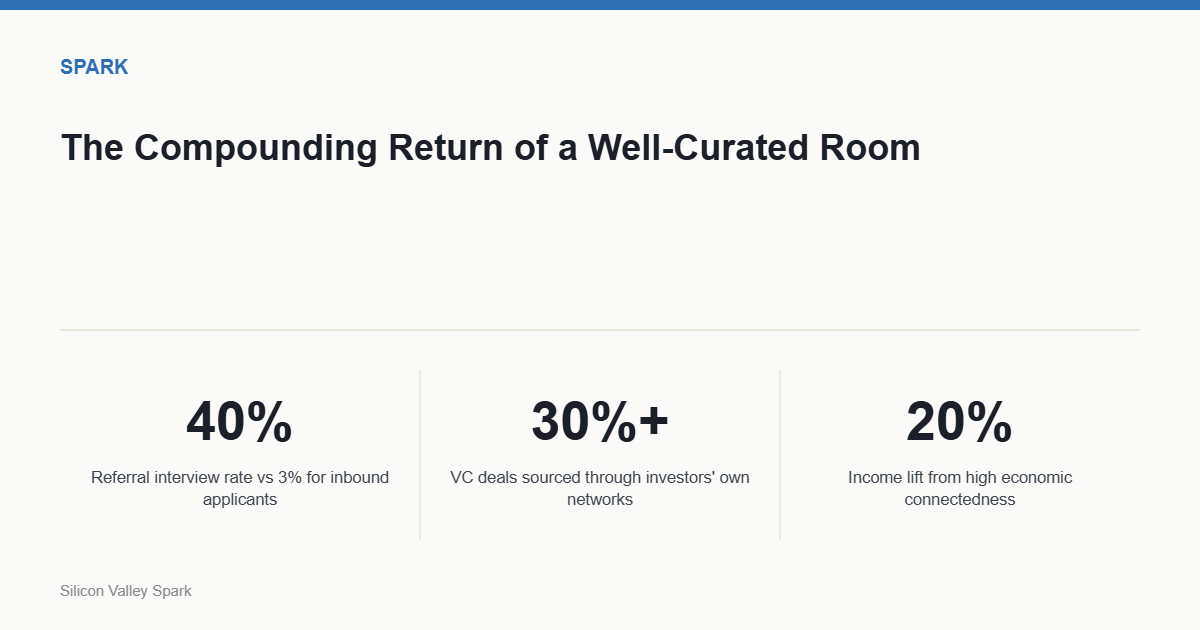
Start with hiring. Ashby's Talent Trends analysis of more than 38 million job applications across 93,000 roles found that referred candidates convert from application to interview at 40%, compared with just 3% for candidates who apply cold through inbound channels, according to Ashby. The gap holds through the next stage of the funnel too: referred candidates who make it to an interview reach an offer 16% of the time, versus 6% for inbound and sourced candidates. A referral is not a nice-to-have add-on to a hiring process. It is a different funnel, with a different conversion curve, running in parallel to everything else a company is doing to find talent.
Venture funding tells a similar story. In a survey of nearly 900 institutional venture capitalists across 681 firms, Harvard Business School researchers Paul Gompers, Will Gornall, Steven Kaplan and Ilya Strebulaev found that more than 30% of deals originate through VCs' own professional networks and another meaningful share arrives as referrals from other investors, while direct inbound pitches from company management account for a much smaller portion of the total, according to the Harvard Law School Forum on Corporate Governance summary of the research. Most institutional capital, in other words, still finds its way to companies through relationships that already exist, not through the widest possible net of cold outreach. The room a founder is in, and the people willing to make an introduction out of it, shapes access to capital as much as the pitch itself.
Why does this pattern hold even as tools for finding people and information keep getting better? Because the value of a connection was never really about access to information. It is about a filter that took real experience to build. Harvard's Opportunity Insights research group, in a study published in Nature, analyzed social connections at national scale and found that economic connectedness, meaning how much people from different economic backgrounds are genuinely connected to one another, is the single strongest predictor of upward mobility identified to date. Children from lower-income households who grow up with the same level of cross-class connection as the average higher-income child go on to earn 20% more in adulthood, on average, according to the research. That is not a statement about any one introduction. It is a statement about what a well-connected community does to outcomes over a full career, compounding quietly in the background long after any single conversation is forgotten.
This is the case for treating curated rooms and warm introductions as an economic channel rather than a courtesy. A room of founders, operators and investors who already trust one another's judgment does two things that a broader, colder audience cannot: it raises the odds that any single introduction lands, and it raises the quality of what gets introduced in the first place, because the people making the connection have already done a first pass of judgment on both sides. That combination, higher hit rate and higher quality per hit, is what shows up in the hiring and fundraising data above.
It is also why curated networks hold their value in a period when information itself has become abundant and nearly free. Search, research and outreach tools can now surface almost anyone. What they cannot manufacture is the trust that makes a stranger take a meeting, skip the skepticism reserved for cold contact, and move faster because someone they respect already vouched for the fit. That trust accumulates over years of people showing up for one another in the same rooms, on the same calls and around the same tables. It cannot be generated on demand, which is exactly why it keeps its value as everything easier to copy becomes commoditized.
Silicon Valley Spark exists inside that logic. It convenes founders, operators and investors and makes introductions between them, on the premise that the return on a well-placed connection is measurable and durable, not incidental. The evidence above suggests that premise is not sentimental. Referral-sourced hires clear the funnel at multiples of the cold-channel rate. Warm-network deal flow still accounts for the majority of venture activity. And the underlying research on economic connectedness suggests the effect compounds well beyond any single hire or check. The practical implication for anyone building a company is straightforward: the introductions in front of you today, and the room you choose to be part of, are already doing quiet, compounding work on your behalf.